So today’s thread is to facilitate some discussion. It requires us to go back in time a bit and look at the logic of the beautiful (in my opinion at least) Displaywriter’s name. This PC came out in a time during which people had been writing on typewriters. For those of you who haven’t noticed: TYPE-writer; DISPLAY-writer. Yeah.
It seems obvious to me that IBM was attempting to nudge people into the newly formed PC market by using a title that invoked familiarity. You know, because human beings, the most intelligent species on planet Earth, don’t recognize the benefits that change usually brings and need to be tricked (in a way) into embracing it. Any way, their t̶r̶i̶c̶k̶ strategy seemed to work, as they released future software products under the same name. How is this relevant to us?
Today, pretty much the entirety of the keyboard enthusiast community can claim to love old-school typewriters (although we may not love the unreasonable and unrealistic difficulty that’s accompanied in using one). Another reason the Displaywriter was called the Displaywriter was because it was amongst the first of the Beam-Springs (if I’m not mistaken), a line of keyboards that feel remarkably similar to typewriters. So here’s my question: Which modern keyboard do you think feels most like an old-school (old-school=take you pick. IBM Selectrics, I guess?) typewriter? If you could build your own, what would it be like? What features? Which switch would you use as a starting point? Which board (as a starting point)? What layout would it be? Would you choose full, TKL, or 60%? Ergonomic? Qwerty, Dvorak? Etc……
Best "Displaywriter"?
-
jacobolus
- Location: geekhack ergonomics subforum
- Favorite switch: Alps plate spring; clicky SMK
- DT Pro Member: -
First, note that beam spring switches don’t really feel *that* much like Selectrics, and definitely don’t feel like older manual typewriters.
The keycaps would be sculpted spherical, like the Alps caps on Canon typewriters from the 80s, or like the nice spherical Alps dyesubs from certain C.Itoh boards (hard to see in this picture, but..):

I’d make a slightly more aggressive sculpted profile than either of those though, with a somewhat flatter home row.
Trying to make something like a “typewriter” in layout is stupid. It should be shaped to the hands:

And it should be tented about 30–45°, turned inward a bit, and slanted appropriately to match desk/lap height.
I’d stick a trackball in the middle.
Modern keyboard? None of them really. The closest you’ll get on boards you can buy new today are Unicomp keyboards and Matias clicky switch boards (or possibly Topre depending on which aspects of the switch are important to you). Unicomp boards are all much wider than typewriters, so I guess your best bet is probably a Matias Mini TactilePro.
How much are we building from scratch here? If I could design the switches but had to base them off something that already exists (i.e. if I didn’t have a few years to figure out a totally new switch concept) it would be something like a cross between Alps plate/beam spring switches and Marquardt “butterfly” beam/plate spring switches, maybe with a different switching mechanism.If you could build your own, what would it be like? What features? Which switch would you use as a starting point? Which board (as a starting point)? What layout would it be? Would you choose full, TKL, or 60%? Ergonomic? Qwerty, Dvorak? Etc……
The keycaps would be sculpted spherical, like the Alps caps on Canon typewriters from the 80s, or like the nice spherical Alps dyesubs from certain C.Itoh boards (hard to see in this picture, but..):
I’d make a slightly more aggressive sculpted profile than either of those though, with a somewhat flatter home row.
Trying to make something like a “typewriter” in layout is stupid. It should be shaped to the hands:
And it should be tented about 30–45°, turned inward a bit, and slanted appropriately to match desk/lap height.
I’d stick a trackball in the middle.
-
Ace

- §
- Location: TX, USA
- Main mouse: Magic Mouse/Trackpad 2
- Favorite switch: Membrane Buckling Spring
- DT Pro Member: -
It all depends on you. It would take years (as you stated) to come up with an entirely new switch concept, so that flies out the window for the purpose of this thread.
When I said modern keyboard, I suppose I didn't mean modern at all. I essentially meant all boards Model F and up (stupid of me to write in the first place). I'm sort of surprised you decided to include aspects from butterfly switches; those aren't very popular at all. May I ask why you went with those? What aspects do you like about them?
And what even is that last board? A custom Ergodox?!
When I said modern keyboard, I suppose I didn't mean modern at all. I essentially meant all boards Model F and up (stupid of me to write in the first place). I'm sort of surprised you decided to include aspects from butterfly switches; those aren't very popular at all. May I ask why you went with those? What aspects do you like about them?
And what even is that last board? A custom Ergodox?!
-
jacobolus
- Location: geekhack ergonomics subforum
- Favorite switch: Alps plate spring; clicky SMK
- DT Pro Member: -
http://deskthority.net/wiki/Marquardt_Butterfly
Not very popular because they were only available (to my knowledge) in a few models of Olympia typewriters from the mid 1980s, which cost thousands of dollars at the time, and are quite hard to find today.
-
bhtooefr

- Location: Newark, OH, USA
- Main keyboard: TEX Shinobi
- Main mouse: TrackPoint IV
- Favorite switch: IBM Selectric (not a switch, I know)
- DT Pro Member: 0056
- Contact:
If we're going from a Selectric, then of what I've tried, the closest is Alps SKCM, but even it's not close - too short travel is only the first of the problems. It's actually impossible for a computer keyboard switch to feel quite like a Selectric without an additional source of energy applied to the mechanics of the switch.
As far as other old-school typewriters, I haven't typed on an electric typebar machine in quite a while, although IIRC they're linear? So MX blacks would probably adequately come close, although they're shorter travel - typewriters had looooooong travel.
And, for a manual typewriter, you'll need an extremely long travel and extremely stiff linear switch that doesn't actuate until bottoming out.
As far as other old-school typewriters, I haven't typed on an electric typebar machine in quite a while, although IIRC they're linear? So MX blacks would probably adequately come close, although they're shorter travel - typewriters had looooooong travel.
And, for a manual typewriter, you'll need an extremely long travel and extremely stiff linear switch that doesn't actuate until bottoming out.
-
Mal-2

- Location: Los Angeles, CA
- Main keyboard: Cherry G86-61400
- Main mouse: Generic 6-button "gaming mouse"
- Favorite switch: Probably buckling spring, but love them Blues too
- DT Pro Member: -
- Contact:
It's worse than that. I learned to type on a manual typewriter, and it took me years of intensive keyboard therapy to recover.
 If you don't hit the bottom of the travel hard enough, the type bar doesn't strike the page at all because there is a certain amount of resistance when it tries to release the pawl that tells the carriage it should advance once the key is released. A little bit more effort, and you get half a character or a mere smudge. You not only have to bottom out every key, you have to bottom it out fairly hard.
The key tops are also tiny, probably to allow more clearance for this very long travel without brushing against other keys. It still means your fingertip has to come almost straight down on the key, no finger-stretching reaches allowed.
Finally — return key, what's that? They had a long lever on the left you had to reach up and push to return the carriage from wherever it was on the left all the way to the far right. The Selectric and its moving head is much more sane.
I would never emulate a manual typewriter, except as historical "we had to walk to school in the snow, uphill both ways" sadism to inflict on people.
-
XMIT

- [ XMIT ]
- Location: Austin, TX area
- Main keyboard: XMIT Hall Effect
- Main mouse: CST L-Trac Trackball
- Favorite switch: XMIT 60g Tactile Hall Effect
- DT Pro Member: 0093
Mal-2 you sound just like my friend who loves manual typewriters. He has a Remington and I enjoy it just as much as he does. In college he used to hand in papers typed on the typewriter much to the amusement of his instructors.
In fact he was just here yesterday trying out my Selectric II. By comparison the electric typewriter allows a much lighter keypress, much faster typing, and - - N key rollover! Indeed, I was able to type ten characters in a row without lifting a finger. (I didn't try more than 10.) It even has a big key to the right that gives you a carriage return *and* a line feed!
If I had some repeatable, precise way of measuring key travel and force I'd like to compare my friend's Remington, the Selectric II and a beam spring. (Still need to find a beam spring...)
Wasn't HaaTa working on a force-travel measuring apparatus?
In fact he was just here yesterday trying out my Selectric II. By comparison the electric typewriter allows a much lighter keypress, much faster typing, and -
- N key rollover! Indeed, I was able to type ten characters in a row without lifting a finger. (I didn't try more than 10.) It even has a big key to the right that gives you a carriage return *and* a line feed!If I had some repeatable, precise way of measuring key travel and force I'd like to compare my friend's Remington, the Selectric II and a beam spring. (Still need to find a beam spring...)
Wasn't HaaTa working on a force-travel measuring apparatus?
-
bhtooefr
- Location: Newark, OH, USA
- Main keyboard: TEX Shinobi
- Main mouse: TrackPoint IV
- Favorite switch: IBM Selectric (not a switch, I know)
- DT Pro Member: 0056
- Contact:
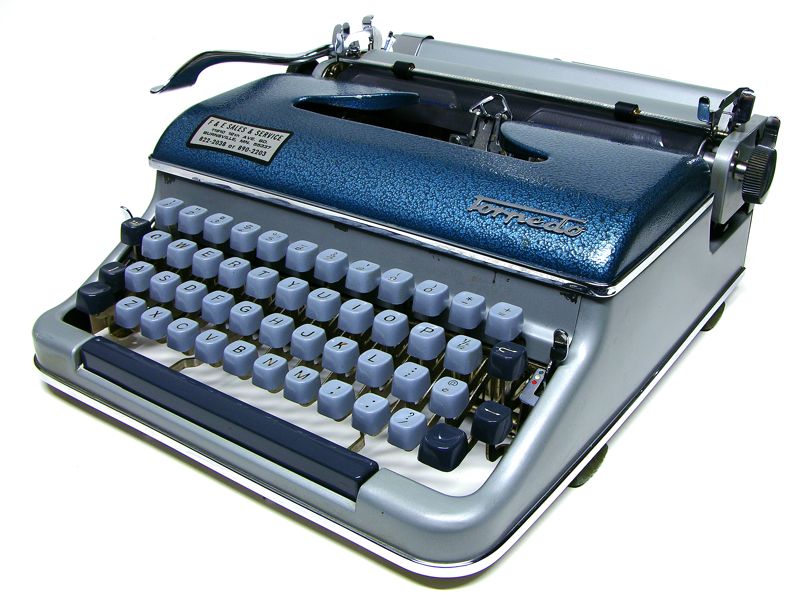
I've got a Torpedo Model 18b that has ribbon feed issues, but is actually the nicest manual typewriter I've ever typed on:
(not mine)
That doesn't mean it's actually easy to type on, it just means that it's got relatively crisp action, and lower force than other manuals I've used. Still gotta type hard, or go home.
(not mine)
That doesn't mean it's actually easy to type on, it just means that it's got relatively crisp action, and lower force than other manuals I've used. Still gotta type hard, or go home.
-
seebart

- Offtopicthority Instigator
- Location: Germany
- Main keyboard: Rotation
- Main mouse: Steelseries Sensei
- Favorite switch: IBM capacitive buckling spring
- DT Pro Member: 0061
- Contact:
the manual typewriter differs more as a whole from the early computer keyboards than those do from say an Model M. So for me the manual typewriter is not comparable at all to any keyboard in my opinion. But I do agree with you AbuBakr Akram that manufacturers of very early keyboards must have looked at the manual typewriter as a reference in some way.
Of all the switches that I own the Micro Switch hall effect linear are the closest in feel to a manual typewriter with a long travel and a clear feedback on bottom out. But even those switches are miles away from the manual typewriter experience. But of course I do not know how many really old keyboard switches feel so I cannot answer your question.
If I could build my own right now I would order some Clare-Pendar Reed Contact Switches and Clare-Pendar Keytops from facetsesame`s groupbuy. The caps would have to be honey sphericals. The case would have to be metal and I would design the whole keyboard to have a similar appearance of a compact beam spring type keyboard in TKL format. It would of course need a modern controller anyway but apart from USB I don´t really need special functions or connectivity. I am actually planning building something like this with my mystery clare pendar keyboard but it will only happen if I can get a new metal case custom built which is a long shot at the moment.
Of all the switches that I own the Micro Switch hall effect linear are the closest in feel to a manual typewriter with a long travel and a clear feedback on bottom out. But even those switches are miles away from the manual typewriter experience. But of course I do not know how many really old keyboard switches feel so I cannot answer your question.
If I could build my own right now I would order some Clare-Pendar Reed Contact Switches and Clare-Pendar Keytops from facetsesame`s groupbuy. The caps would have to be honey sphericals. The case would have to be metal and I would design the whole keyboard to have a similar appearance of a compact beam spring type keyboard in TKL format. It would of course need a modern controller anyway but apart from USB I don´t really need special functions or connectivity. I am actually planning building something like this with my mystery clare pendar keyboard but it will only happen if I can get a new metal case custom built which is a long shot at the moment.