Modeling an F key mechanism
- DMA
- Location: Seattle, US
- Main keyboard: T420
- Main mouse: Trackpoint
- Favorite switch: beamspring
- DT Pro Member: NaN
- Contact:
Turns out, using MX stabilizers is quite tricky with buckling spring mechanisms: barrel top is 0.6mm above the top plate and all the dust and bread crumbs will go straight under the flipper.
So one either needs to severely redesign key travel limiter or add dust caps to the stems.
Added dust caps today. Not sure they warp when molded - I want to have a flat side so that LED can be added, and post-molding shrinking of the assymmetric part can be problematic.. Will think about travel limiter redesign. horizontal plates are, from the top, MX cross base (5.6mm above plate), plate, PCB.
So one either needs to severely redesign key travel limiter or add dust caps to the stems.
Added dust caps today. Not sure they warp when molded - I want to have a flat side so that LED can be added, and post-molding shrinking of the assymmetric part can be problematic.. Will think about travel limiter redesign. horizontal plates are, from the top, MX cross base (5.6mm above plate), plate, PCB.
- Attachments
-
- barrel-side-pressed.jpg (138.3 KiB) Viewed 352 times
- DMA
- Location: Seattle, US
- Main keyboard: T420
- Main mouse: Trackpoint
- Favorite switch: beamspring
- DT Pro Member: NaN
- Contact:
attached dust sleeves to barrels relatively easily. Supporting wall came about 0.75mm thick - should be enough for people not explicitly trying to break the key, I guess. Increasing barrel diameter should provide more sturdiness - but can cause barrel to keycap contact.
I guess I'm close to actually trying to find somebody who can do injection molding of these. Any ideas who can do it?
- DMA
- Location: Seattle, US
- Main keyboard: T420
- Main mouse: Trackpoint
- Favorite switch: beamspring
- DT Pro Member: NaN
- Contact:
Printed!
It's moderately scratchy and moderately wobbly (kinda comparable to MX switches I have, may be tad more. Comparable to model F, actually).
It doesn't bind.
It doesn't click either. I mean it clicks outside of the barrel. It clicks when key is all the way down and flipper disturbed. The spring resets when key gets back up. It just doesn't click when fully assembled. Key travel is 3.8mm - but actuation is somehow even lower.
PS: Noticed a weird thing: assembled model F actuates at around 2mm travel, and original parts assembled on the table at around 3. Turns out, it does matter how spring is mounted: mounting spring in a correct position (see Fig. 1) produces initial incline (see Fig. 2) of about 5 degrees, which - together with initial ~2.5mm of compression pre-bends the spring, setting the direction of future buckling, as well as dictating it's future direction.
Interestingly, Brother flavor of buckling spring is mounted strictly vertically. And they buckle at ~3mm! Except Brother pre-compresses their spring 1mm more (and key stem end actually stops ~0.5mm below the flipper's bottom!) - so I'm kinda lucky my "improperly mounted model F" buckes at 3mm.
Also, Brother springs are essentially model M - so it looks like that extra 15 grams of force are coming solely from that extra 1mm of spring compression!
Fig. 1: correct spring placement Fig. 2: initial angling of the spring
It doesn't bind.
It doesn't click either. I mean it clicks outside of the barrel. It clicks when key is all the way down and flipper disturbed. The spring resets when key gets back up. It just doesn't click when fully assembled. Key travel is 3.8mm - but actuation is somehow even lower.
PS: Noticed a weird thing: assembled model F actuates at around 2mm travel, and original parts assembled on the table at around 3. Turns out, it does matter how spring is mounted: mounting spring in a correct position (see Fig. 1) produces initial incline (see Fig. 2) of about 5 degrees, which - together with initial ~2.5mm of compression pre-bends the spring, setting the direction of future buckling, as well as dictating it's future direction.
Interestingly, Brother flavor of buckling spring is mounted strictly vertically. And they buckle at ~3mm! Except Brother pre-compresses their spring 1mm more (and key stem end actually stops ~0.5mm below the flipper's bottom!) - so I'm kinda lucky my "improperly mounted model F" buckes at 3mm.
Also, Brother springs are essentially model M - so it looks like that extra 15 grams of force are coming solely from that extra 1mm of spring compression!
Fig. 1: correct spring placement Fig. 2: initial angling of the spring
- DMA
- Location: Seattle, US
- Main keyboard: T420
- Main mouse: Trackpoint
- Favorite switch: beamspring
- DT Pro Member: NaN
- Contact:
And so, I quickly designed some test flippers with varying degree of spring slant: 5 degree (varying spring support height), and 10 degree with default height.
Results: (flipper - actuation point)
5° - 3.5mm
5°+0.5mm - 2.75mm
5°+1mm - 2mm
5°+1.5mm - 1.5mm (fails to reset)
10° - 2mm
Somehow 5°+1mm feels crispier than 10°, and 5°+0.5mm even crispier - probably because the spring manages to store more energy before buckling, or there is such thing as too much pre-bending of the spring, so it buckles too readily - who knows!
Results: (flipper - actuation point)
5° - 3.5mm
5°+0.5mm - 2.75mm
5°+1mm - 2mm
5°+1.5mm - 1.5mm (fails to reset)
10° - 2mm
Somehow 5°+1mm feels crispier than 10°, and 5°+0.5mm even crispier - probably because the spring manages to store more energy before buckling, or there is such thing as too much pre-bending of the spring, so it buckles too readily - who knows!
- DMA
- Location: Seattle, US
- Main keyboard: T420
- Main mouse: Trackpoint
- Favorite switch: beamspring
- DT Pro Member: NaN
- Contact:
Quoted barrel and stem at protolabs.com
Stem:
up to 1000 copies: $6385 + $2.83/copy. 1000 shots = $9215 = $9.215/shot
20k - 1 cavity: $9580 + $1.35/copy, total $33780 = $1.689/shot
20k - 8 cavities: $49140 + $0.50/copy, total $59140 = $2.957/shot
Barrel:
up to 1000 copies: $7430 + $2.82/copy. 1000 shots = $10,250.00 = $10.25/shot
20k - 1 cavity: $11145 + $1.21/copy, total $35345 = $1.767/shot
20k - 8 cavities: $52305 + $0.51/copy, total $62505 = $3.125/shot
So, standard 87-key keyboard is $222.72 for just the keys, not even springs or flippers - plus $20725 in tooling.
Or, $87.87 + $101445 in tooling.
Looks like it's not really feasible as a group buy without kickstarter. I kinda had an idea to make a limited run of 100 TKLs with nice 2-digit serials - but this puts the price way north of $2k per unit..
Stem:
up to 1000 copies: $6385 + $2.83/copy. 1000 shots = $9215 = $9.215/shot
20k - 1 cavity: $9580 + $1.35/copy, total $33780 = $1.689/shot
20k - 8 cavities: $49140 + $0.50/copy, total $59140 = $2.957/shot
Barrel:
up to 1000 copies: $7430 + $2.82/copy. 1000 shots = $10,250.00 = $10.25/shot
20k - 1 cavity: $11145 + $1.21/copy, total $35345 = $1.767/shot
20k - 8 cavities: $52305 + $0.51/copy, total $62505 = $3.125/shot
So, standard 87-key keyboard is $222.72 for just the keys, not even springs or flippers - plus $20725 in tooling.
Or, $87.87 + $101445 in tooling.
Looks like it's not really feasible as a group buy without kickstarter. I kinda had an idea to make a limited run of 100 TKLs with nice 2-digit serials - but this puts the price way north of $2k per unit..
- DMA
- Location: Seattle, US
- Main keyboard: T420
- Main mouse: Trackpoint
- Favorite switch: beamspring
- DT Pro Member: NaN
- Contact:
..by experimenting with spring support length & angle I discovered a configuration which only clicks on the keypress - return trip is silent (unless you flick the key - this way stem hits the barrel on the way back with a pretty loud "thud" - but you need to be really intentional about it, even on medium-speed typing the rebound is pretty silent).
I also discovered a configuration that's nearly silent - but still tactile! (Also, turns out tactility is greatly hampered by 3D-printed surface roughness. Not only that - the key whistles as it moves, too
)
So I'm kinda ready to mold the switches - if there's anybody alive out there for a group buy.
I also discovered a configuration that's nearly silent - but still tactile! (Also, turns out tactility is greatly hampered by 3D-printed surface roughness. Not only that - the key whistles as it moves, too
So I'm kinda ready to mold the switches - if there's anybody alive out there for a group buy.
- kbdfr
- The Tiproman
- Location: Berlin, Germany
- Main keyboard: Tipro MID-QM-128A + two Tipro matrix modules
- Main mouse: Contour Rollermouse Pro
- Favorite switch: Cherry black
- DT Pro Member: 0010
Not being an IBM guy, I have no use for all that,
but I do admire all the energy, care and precision you are unfolding here.
-
Green Maned Lion
- Location: USA
- Main keyboard: Unicomp New Model M
- Main mouse: X-keys L-Track
- Favorite switch: Buckling Spring
How could anyone not be an IBM person?kbdfr wrote: 11 Feb 2026, 08:31 Not being an IBM guy, I have no use for all that,
but I do admire all the energy, care and precision you are unfolding here.
- vvp
- Main keyboard: Katy/K84CS
- Main mouse: symetric 5-buttons + wheel
- Favorite switch: Cherry MX
- DT Pro Member: -
- DMA
- Location: Seattle, US
- Main keyboard: T420
- Main mouse: Trackpoint
- Favorite switch: beamspring
- DT Pro Member: NaN
- Contact:
Easily doable.
In fact the more keys the better - larger number of switches drives cost per unit down.
- DMA
- Location: Seattle, US
- Main keyboard: T420
- Main mouse: Trackpoint
- Favorite switch: beamspring
- DT Pro Member: NaN
- Contact:
Today I remembered that with 3D printing one doesn't need to drill into things to see what's inside - can just punch a hole in the model itself and print.
So I now have a see-thru barrel and a see-thru stem.
Also I wanted to see what will happen if I make the spring rest angle sharper. Turns out, it becomes a momentary switch: the spring buckles, but there's not enough space - so it springs back as you press the key further. On the trip up, it produces another keypress.
Also I experimented with flipper size - thinner paddle, paddle so narrow it's a finger, and no paddle at all. Turns out, loudness of the click is kinda proportional to flipper mass - the heavier the flipper, the louder the click - while tactility is not affected at all. This paves the way for an office friendly model F, keeping all of the wonderful tactility (and supposed ergononic benefits with it), but having almost no click - with a single part change vs standard model! Also, EXTRA-THICC FLIPPERS for the extra-loud slaps!
(probably material also plays a role - ABS-like resin light flipper is 190mg, heavy is 220mg, and original model F one is 260mg and kind of disproportionately louder)
Also I experimented with flipper size - thinner paddle, paddle so narrow it's a finger, and no paddle at all. Turns out, loudness of the click is kinda proportional to flipper mass - the heavier the flipper, the louder the click - while tactility is not affected at all. This paves the way for an office friendly model F, keeping all of the wonderful tactility (and supposed ergononic benefits with it), but having almost no click - with a single part change vs standard model! Also, EXTRA-THICC FLIPPERS for the extra-loud slaps!
(probably material also plays a role - ABS-like resin light flipper is 190mg, heavy is 220mg, and original model F one is 260mg and kind of disproportionately louder)
- DMA
- Location: Seattle, US
- Main keyboard: T420
- Main mouse: Trackpoint
- Favorite switch: beamspring
- DT Pro Member: NaN
- Contact:
Printed GINORMOUS 320mg and 350mg flippers:
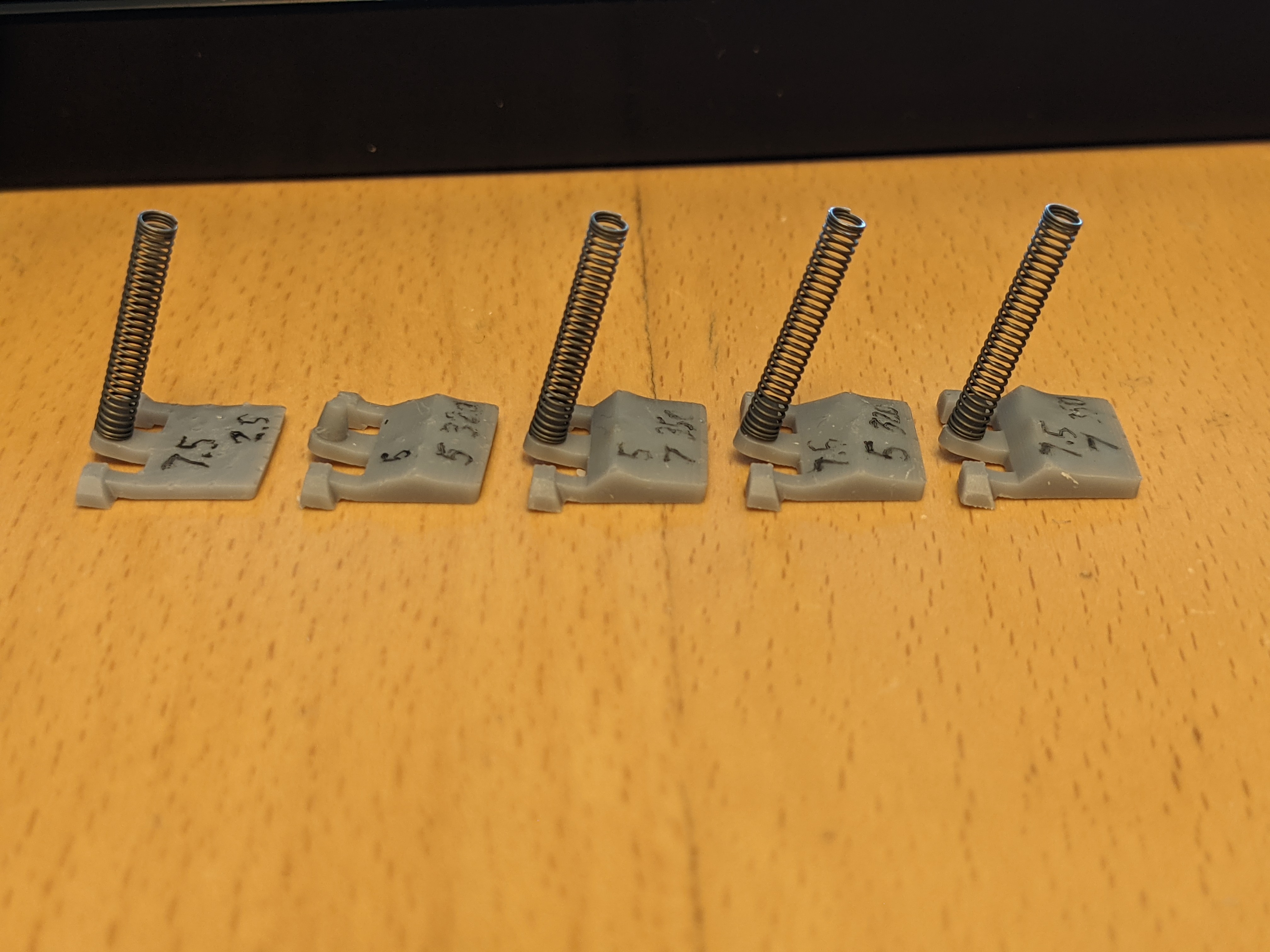
Boy, do those SLAP! Checkmate!
I think it's because heavier flipper spends more time in flight, so spring has time to pump more energy into it (a = F/m, higher m -> lower a -> longer travel time).
Seems like 5-degree are slappier - also likely because of greater flipper impact energy: those activate deeper, so spring stores more energy at buckling time, resulting in greater force (which should result in flipper reaching the impact faster - but maybe total energy is still higher somehow - who knows..)
Also, 40-degree spring stand slope works, not worse than 45 - but should help with spring catching on the spring slide in assembly. Spring can still catch at the slope and not seat properly - Ellipse's keys not seating properly when spring is not totally vertical are likely exactly this problem: stem molds not being polished enough in the spring guide area, resulting in not smooth enough spring slide.
I found that pressing all the way down and then removing my finger tothe side has a good chance to reseat the spring properly - at least on my 3D-printed stems.
Tried to print couple solutions to aid re-seating - nothing worked so far, but I'm not out of ideas either.
Boy, do those SLAP! Checkmate!
I think it's because heavier flipper spends more time in flight, so spring has time to pump more energy into it (a = F/m, higher m -> lower a -> longer travel time).
Seems like 5-degree are slappier - also likely because of greater flipper impact energy: those activate deeper, so spring stores more energy at buckling time, resulting in greater force (which should result in flipper reaching the impact faster - but maybe total energy is still higher somehow - who knows..)
Also, 40-degree spring stand slope works, not worse than 45 - but should help with spring catching on the spring slide in assembly. Spring can still catch at the slope and not seat properly - Ellipse's keys not seating properly when spring is not totally vertical are likely exactly this problem: stem molds not being polished enough in the spring guide area, resulting in not smooth enough spring slide.
I found that pressing all the way down and then removing my finger tothe side has a good chance to reseat the spring properly - at least on my 3D-printed stems.
Tried to print couple solutions to aid re-seating - nothing worked so far, but I'm not out of ideas either.